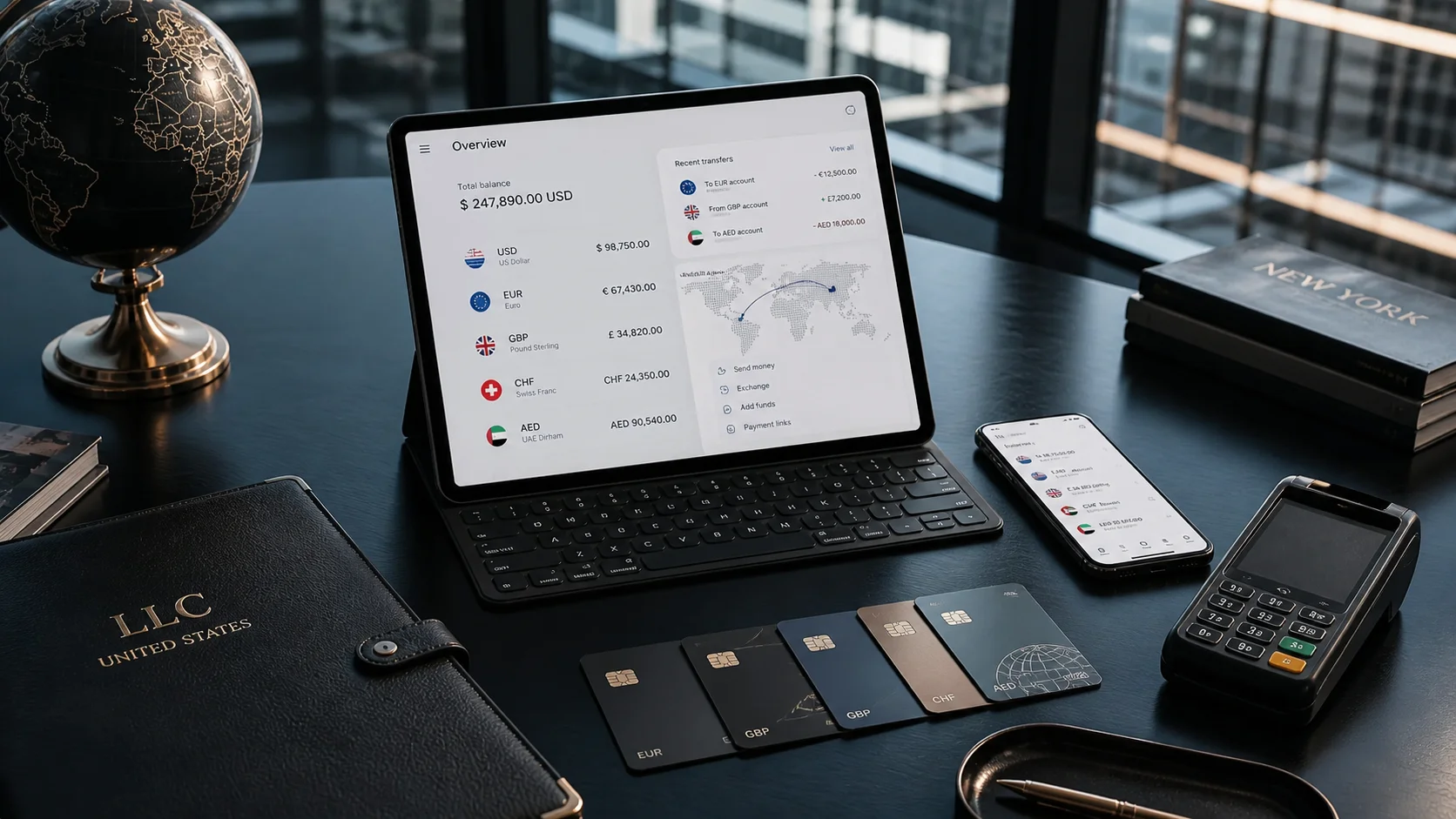
Most banking jurisdictions trade off one feature for another. Western Europe gives you institutional credibility but punishes you with KYC theatre. Caribbean offshore banks are fast but carry compliance baggage. Singapore is premium but the minimums have crept up to where it's no longer accessible to mid-sized founders.
Georgia, the country, sits in a quietly attractive position: full-service banking, multi-currency accounts including CHF (which is hard to obtain almost anywhere else), and premium card products that cost a fraction of what European banks charge for less. None of which has been compromised by the regulatory drift hitting Europe.
If you already have a US LLC or operate internationally, a Georgian bank account is a serious complement to your stack — not a replacement, but an upgrade.
What Georgia Actually Offers Non-Residents
The headline features that drive founder interest:
- Multi-currency accounts in USD, EUR, GBP, GEL, and (this matters) CHF. Swiss Franc accounts are difficult to obtain in most jurisdictions outside of Switzerland itself and a handful of EU private banks. Georgian banks issue them routinely to non-residents.
- Remote-friendly onboarding at the major banks. Pre-approval is possible online; in-person verification is a single visit (usually under an hour) on the day you arrive in Tbilisi.
- Premium card products — concierge, lounge access, priority counters, metal cards — at price points 10-20% of what comparable products cost at HSBC Premier, BNP Privée, or Coutts.
- Friendly to international structures. Georgian banks are accustomed to onboarding non-residents with US LLCs, BVI companies, Cypriot holdings, and crypto-adjacent businesses. The de-risking pressure that has gripped EU retail banks hasn't reached Tbilisi.
The CHF Angle
This is the feature most underrated outside the founder community.
A CHF account is useful for several reasons:
- Currency hedging. CHF is one of the world's most stable currencies — historically a safe haven during financial stress. Holding 5-15% of company reserves in CHF is a reasonable hedge against EUR or USD instability without the complexity of metals.
- Swiss vendor payments. If any part of your operation involves Swiss services (consultants, software firms, family office providers), having a CHF account means you can pay in CHF without losing 1-2% on each conversion.
- Diversification of banking jurisdiction. Holding USD in the US, EUR in Belgium (via Wise), and CHF in Georgia means a single jurisdictional shock doesn't take out your entire treasury.
The friction with CHF accounts: Swiss banks themselves require minimum deposits in the CHF 250k+ range for non-residents and run extensive KYC. EU banks rarely offer CHF accounts to non-residents at all. Georgian banks (TBC and Bank of Georgia in particular) offer CHF accounts to non-residents with minimums in the $5-25k range.
The Premium Card Paradox
This is where Georgia's offering reads almost unbelievable to anyone used to Western European pricing.
TBC Status (TBC Bank's premium tier):
- Annual fee: ~$300
- Includes: dedicated relationship manager, lounge access (Priority Pass), priority counters, premium debit cards, concierge
- Equivalent service at HSBC Premier in the UK: £700/year ($875)
- Equivalent at BNP Paribas Privilege: €600/year ($630)
Bank of Georgia Solo (Bank of Georgia's premium tier):
- Annual fee: ~$400
- Includes: international travel insurance, Mastercard World Elite, priority customer support, exclusive Solo lounges in Tbilisi and major cities
- Equivalent at Crédit Agricole Excelium: €1,000+/year
The cards are not "cheap because they're worse" — the actual benefit set (insurance, lounge access, concierge) is comparable to the Western European tier products. The price differential reflects local cost structures, not service differential.
For a founder who travels regularly, a Georgian premium tier subscription pays for itself in lounge access and travel insurance alone over the course of a year, and gives you a relationship-managed banking layer for under $400.
Remote Onboarding (and Its Limits)
Here is what's realistic about "remote opening" in Georgia:
What you can do remotely:
- Submit application and KYC documents online
- Pre-approval review (typically 1-3 business days)
- Receive a list of required documents to bring on the visit
What requires an in-person visit:
- Identity verification (yes, you do need to physically appear)
- Card collection (premium cards are not mailed internationally)
- Some account-opening signatures
The good news: a single trip to Tbilisi handles the entire process. Most founders combine the bank visit with broader business setup (residency consultation, IE registration, real estate viewing) into a 2-3 day trip. Direct flights from major European hubs run $200-$500 round-trip; budget hotels in Tbilisi are $50-$80/night.
If you can't travel at all, some private banking arms (TBC Concept, Bank of Georgia VIP) work with introducers who can verify documents abroad and forward them to the bank. This is a higher-friction path; budget 4-8 weeks instead of 2-3.
The Banks That Actually Matter
Not every Georgian bank handles non-residents well. The realistic options:
TBC Bank. The default choice. Strong English-language service, competent international department, full multi-currency offering including CHF. The premium tier (TBC Status) is what most international founders sign up for. Onboarding pre-approval is fast.
Bank of Georgia. The primary alternative. Slightly more relationship-driven, the Solo tier is well-regarded, and the international team is good. Some founders prefer it for crypto-adjacent businesses where TBC has been more cautious.
Credo Bank, Liberty Bank, Basisbank. Smaller players. Useful for niche cases (Credo for crypto, others for specific industries) but not the primary recommendation for most non-residents.
Where Georgia Banking Doesn't Replace Your Stack
To be clear about the limits:
- Not a US replacement for a US LLC. Mercury, Relay, or a regional US bank is still the right primary banking for a US LLC. Georgian banks are excellent secondary banking; they're not optimized for US ACH/wire flows.
- Not for processing customer card payments. Stripe, Adyen, or Mollie remain the answer there. Georgian banking is for holding, treasury, and payments — not merchant acquiring.
- Some KYC pressure on heavy crypto. Even Georgian banks have tightened slightly on accounts that show 30%+ crypto-linked transfers. Diversifying inflows and keeping crypto-specific operations on Kraken/Mercury is the right approach.
Who Should Open in Georgia
This is the right move if you:
- Already operate a multi-jurisdictional structure and want banking diversification
- Need a CHF account and don't want to engage with Swiss minimums
- Want premium banking services (concierge, lounge, insurance) without paying European premium prices
- Have customers, vendors, or family in the Caucasus / Eastern Europe / Central Asia region
- Want a banking jurisdiction that isn't subject to current EU de-risking pressure
It's premature if your operation is single-currency, single-customer-region, and pre-revenue. Don't add complexity until the operational case is real.
Setting It Up
Realistic sequence:
- Choose the bank (TBC for most, Bank of Georgia for specific cases)
- Complete pre-approval online with company documents (LLC articles, EIN if US, BOI, list of beneficial owners)
- Book the trip — 2-3 days in Tbilisi covers the bank visit, pickup of cards, and any related business
- Verify in person at the bank — typically a one-hour appointment
- Activate cards and initial funding — usually $5k-$25k initial deposit, depending on the tier
- Configure the account with your existing accounting and treasury workflows
Total cost for the setup including travel: $1-3k. Total time: 2-3 weeks from start to operational account.
At Leasum, we handle the introduction to TBC and Bank of Georgia for our international clients alongside Georgian residency for those pursuing the 1% IE tax setup. If you're already running a US LLC or international structure and the banking layer is the next thing to upgrade, this is the move worth making in 2026.